You don’t need another writer
You need someone safe enough to untangle the thinking with — who also happens to write.
Every project begins in the same place
Someone stuck, overwhelmed, or sitting on something important they can’t yet articulate.
Sometimes it’s a leader with a book in them. Sometimes it’s a founder navigating a transformation that doesn’t yet have language. Sometimes it’s a CSR or impact team doing remarkable work nobody outside the building has heard about. Sometimes it’s a social enterprise leader changing lives and struggling to make it visible to the people who decide whether it continues.
Different problems, same pattern. The proof is there. What’s missing is the way in. I find it using a values-based story compass. This method’s evolution began with a local community finance newsletter and a phone call from Microsoft UK.
Where this began
In 2006, on the walk home from playgroup, a neighbour asked if I could write a newsletter for a small community development finance initiative. I said yes without thinking much of it. What I didn’t realise was that I’d stumbled into what would become my life’s work: finding stories that move minds — and shaping them so they do.
Someone at Microsoft UK picked up that newsletter and asked who’d written the stories. At the time, I was working as a European technology correspondent — not someone you’d expect Microsoft’s director of citizenship to call. But call me she did. She wanted someone who could find examples of how the company lived its societal values, and shape them into a book of thirty one-minute stories. What I discovered, buried across teams and projects, were stories that nobody had thought to tell, because nobody had recognised their worth.
That project led to a long-term retainer as Microsoft’s CSR newshound, and it crystallised something I’ve carried through every piece of work since:
Organisations doing remarkable work almost always have everything they need to prove it. They just haven’t found the whole story yet — the version that makes people believe, care, and act.
Finding the whole story isn’t something you can automate. It takes a person curious enough to ask, and empathetic enough to be trusted with the answer.
None of this came from nowhere. My grounding is in agency PR and comms — I learned the trade on staff at Kartupelis Associates, Mid Anglia’s leading PR agency in the 1990s, and have since worked as an associate with Clean Comms, OneFishTwoFish, and cofinitive. The brand and PR work came first. Journalism and storytelling grew out of it.
A values-led method
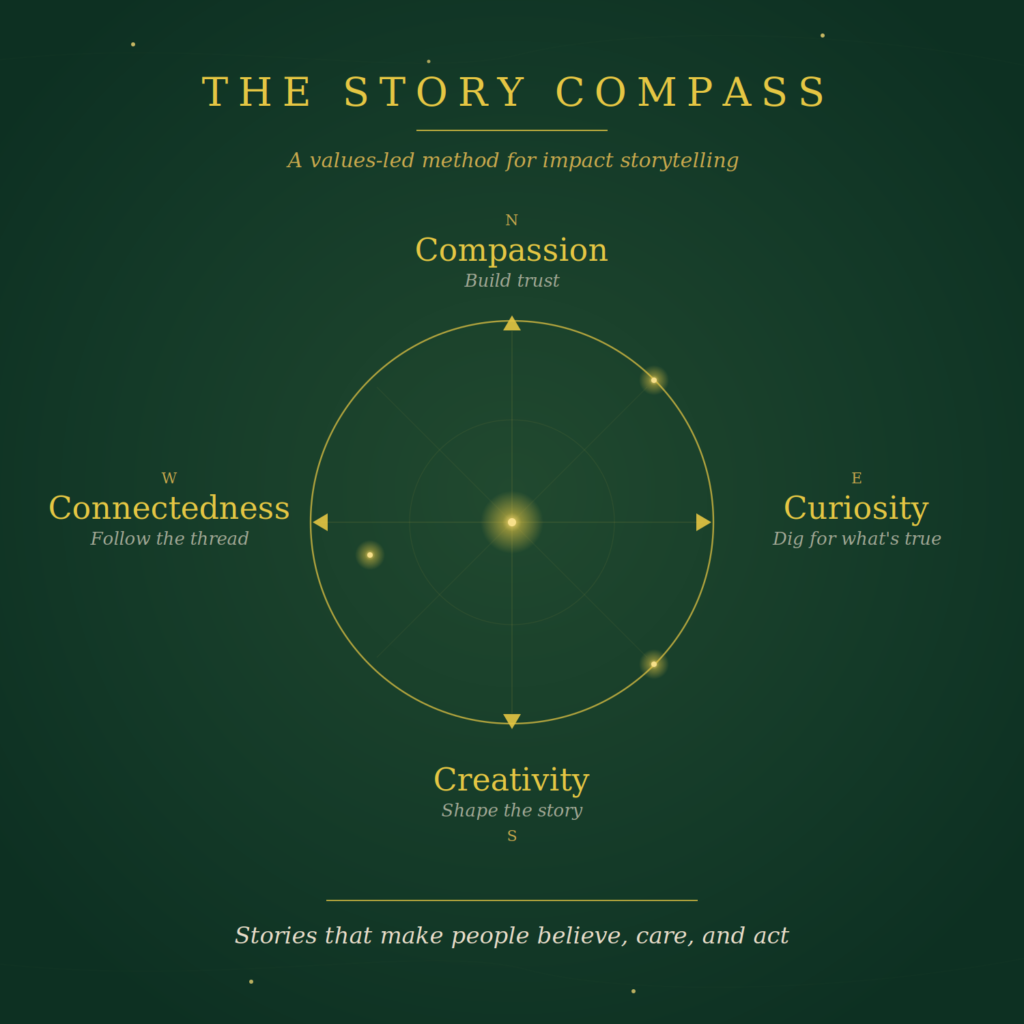
My method is values-led. Four values — compassion, curiosity, creativity, and connectedness — work together to guide every project toward one destination: a story that makes people believe, care, and act.
Here’s how the work unfolds.
1. Compassion: builds trust
→ People share their best thinking when they feel safe. You’ll be listened to, deeply, before we push for the whole story. Clarity emerges from trust, not pressure.
2. Curiosity: digs for what’s true
→ The whole story is usually hidden behind the safe one. I dig for it, then test what I find to ensure it’s true in the parts, honest in the frame, and complete in the picture.
3. Creativity: shapes the story
→ I shape what emerges into something the world can act on — a tangible asset that reaches those whose attention you need and moves them to act.
4. Connectedness: follows the thread
→ Every project belongs inside a bigger story. Together, we find the throughline.
Principles
My principles are non-negotiable. They’re what keep the storytelling honest.
Persuasion, not propaganda: I make strong cases for organisations whose work deserves to be seen — that’s advocacy, and I make no apology for it. The line I won’t cross is fiction dressed as fact. Every claim I help make gets tested for truth before it gets shaped to move people to act — and that testing is human judgement, not something I hand to a machine.
Whole stories that hold: Marketing’s easy temptation is to tell the bit that flatters and leave out the bit that complicates. The trouble is, real questions come — from journalists, funders, sceptics, competitors, customers. The way I work anticipates them. Every story I help shape is true in the details, honest about the framing, and complete enough that nothing important is hidden. The stories that last are the ones built to survive scrutiny.
Good work made visible: The best work is often the quietest about itself. The proof of what an organisation has achieved is usually buried in the work itself — not yet a story outsiders can see. Everything I do serves one aim: making good work impossible to miss.
No good work stays unseen.
No remarkable story stays untold.
No truth stays buried.
Got something important to say?
Tell me where you’re stuck. A few sentences will do.