
I find the stories
nobody thought to tell
Narrative strategist and ghostwriter. 30+ years in strategic communications. 20 years finding the stories hidden inside organisations and experts’ heads.
It began with not being understood
Until I was 7, I went to speech therapy. I struggled to make myself understood, and books became my escape. Stories have run through every job I’ve had since. Along the way, I worked out how to find them. Then I drew the map.
Then came an unexpected call
In 2006, on the walk home from playgroup, a neighbour asked if I could write a newsletter for a small community development finance initiative.
I said yes without thinking much of it.
Someone at Microsoft UK picked up that newsletter and asked who’d written the stories.
At the time, I was working as a European technology correspondent, not someone you’d expect Microsoft’s director of citizenship to call.
But call me, she did.
Hired to research, kept on to write
What I discovered, buried across teams and projects, were stories nobody had thought to tell because nobody had recognised their worth.
That project led to a two-year retainer as Microsoft’s internal newshound – and crystallised something I’ve carried through every piece of work since:
Organisations doing remarkable work almost always have everything they need to prove it. They just haven’t found the whole story yet – the version that makes people believe, care, and act.
Finding the whole story isn’t just a writing task. The draft was never the hard part. Thanks to AI, it certainly isn’t now. The hard part is getting people to tell you the true version, knowing which bits will hold when someone pushes, and making it sound like you at your best.
That neighbour had no idea she’d caught a thread that would run through the rest of my working life: finding stories that move minds, and shaping them so they do.
Neither did I.
The playgroup walk was happenstance. What I did with the opportunity it led to wasn’t. That came from a career that started in agency PR in the 1990s and has since run across brand, journalism, training and development, and storytelling – for organisations ranging from global technology companies to local social enterprises and international impact ventures.
‘Nicki has the ability to communicate the essence of a person, team or organisation. She has done remarkable work, for example, in bringing to life the values of organisations.’
Mike Pegg, author, The Art of Strengths Coaching
Bringing it to life
- Positioning for ieso Digital Health that helped secure $56m in US investment, then three further contracts, including interim head of marketing, and comms across a full platform transformation.
- A CIPR award-winning whitepaper launched at the House of Commons.
- Eight books: six published, two in development. Ghostwriter or developmental editor on seven, co-author on one.
- Work for Microsoft, BT, Waterstones, Cambridge Judge Business School, and social enterprises across the UK and sub-Saharan Africa.
The Story Compass
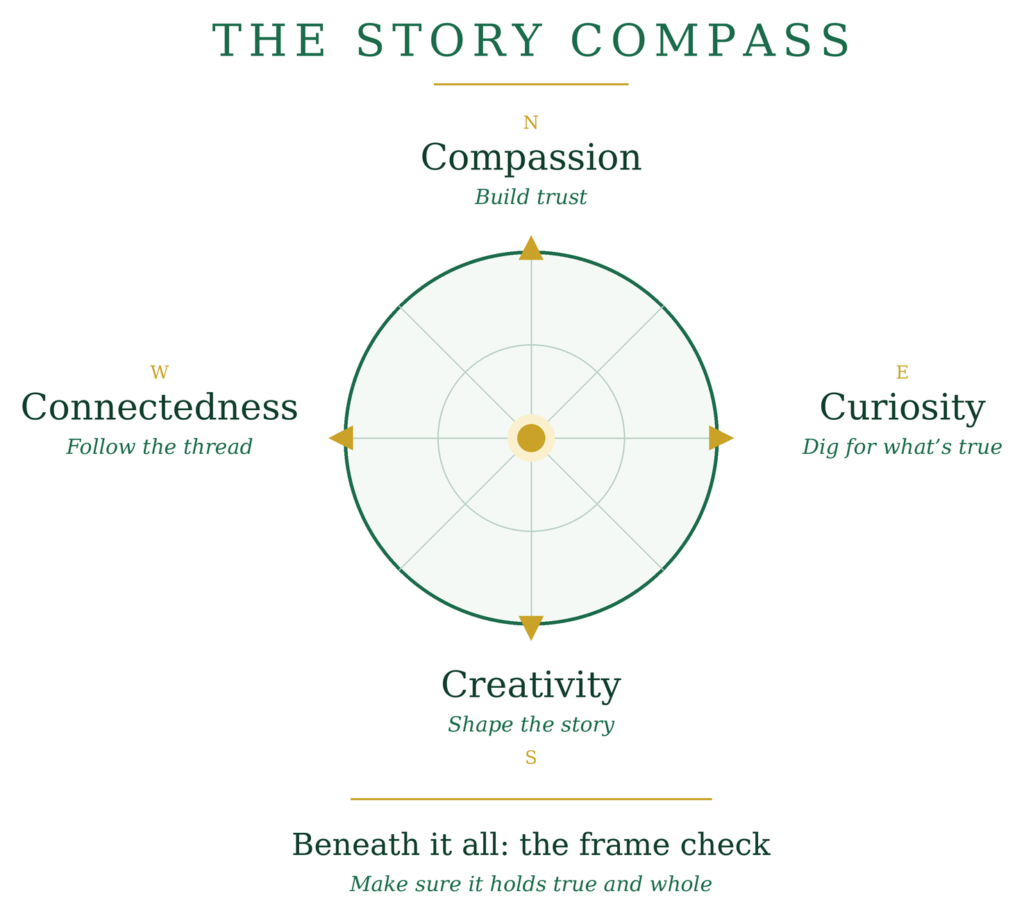
The Story Compass is how I find the story. Four things matter: compassion, curiosity, creativity, and connectedness. Together, they help me get to the story people can believe, care about, and act on. Underneath all four is the frame check: the story has to be true and whole.
1. Compassion: builds trust
→ People share their best thinking when they feel safe. You’ll be listened to properly before we start pushing for the whole story. Clarity emerges from trust, not pressure.
3. Creativity: shapes the story
→ I shape what emerges into something people can understand and act on – something that reaches the people whose attention you need.
2. Curiosity: digs for what’s true
→ The whole story is usually hidden behind the safe one. I dig for it, then test what I find to ensure it’s true in the parts, honest in the frame, and complete enough to hold up when the difficult questions come.
4. Connectedness: follow the thread
→ Every project belongs inside a bigger story. Together, we find the throughline.
Where I draw the line
I make strong cases for work that deserves to be seen. The line I won’t cross is fiction dressed as fact – or a true story framed to prove something it doesn’t. I test what we build until it holds, and prepare you for the questions that will come – from investors and funders, journalists and communities, and the sceptics inside your own organisation.
Got something important to say?
Let me know where you’re stuck. A few sentences will do.